
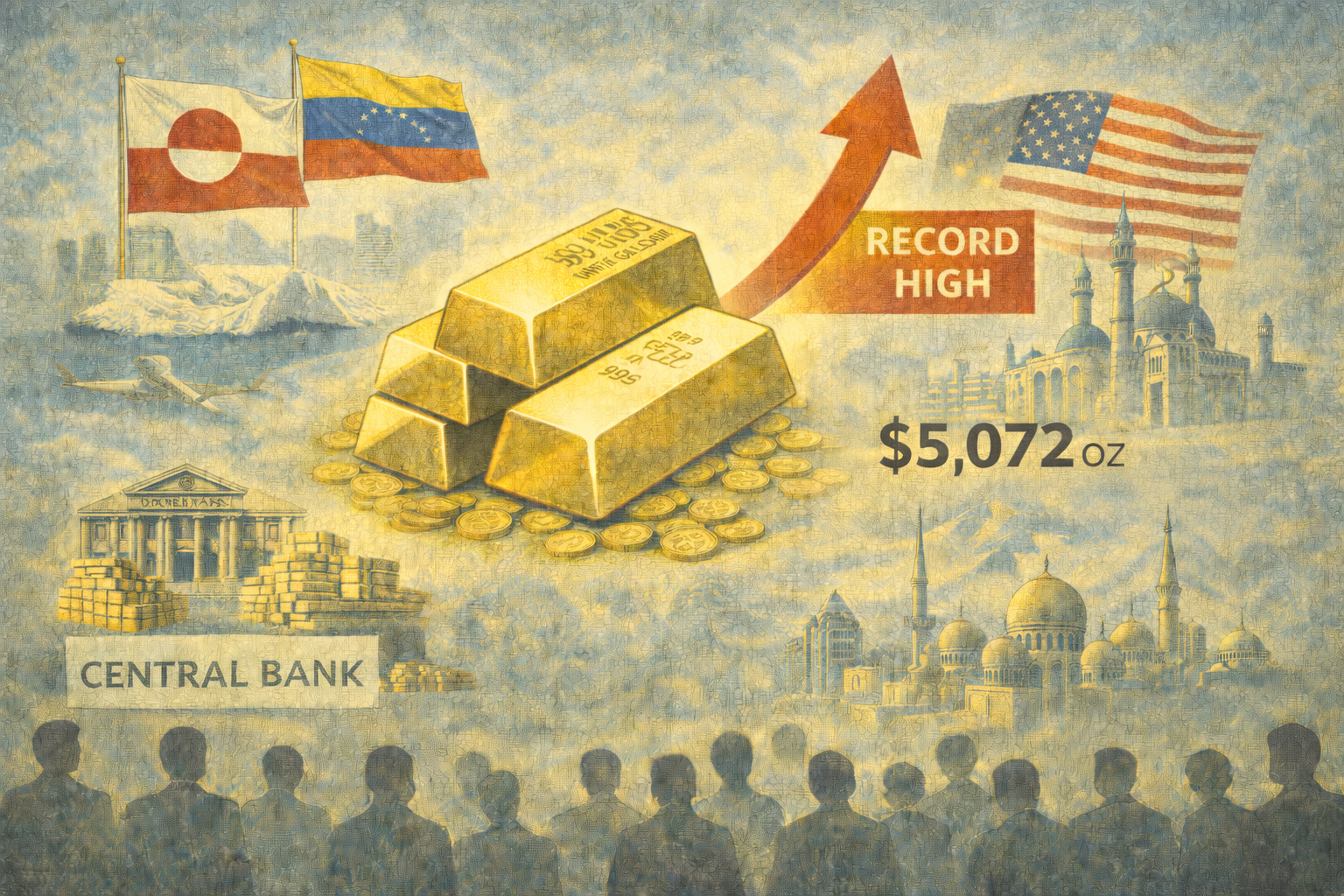
Gold climbed to a fresh all-time high on Monday, crossing the $5,000-an-ounce mark and extending a powerful rally driven by heightened geopolitical tensions and growing concerns over global fiscal stability.
The move underscores gold’s enduring role as a safe-haven asset during periods of uncertainty, as investors continue to seek protection against a volatile macroeconomic and political backdrop.
Spot gold prices gained 1.7% to trade around $5,072 an ounce, while US gold futures for February rose to about $5,070 an ounce.
The advance marked another milestone in what has become a record-breaking run for the precious metal, reflecting sustained demand across a broad range of investors.
Geopolitical tensions fuel safe-haven demand
The latest surge in gold prices comes amid a series of geopolitical flashpoints that have unsettled global markets.
Recent developments spanning Greenland, Venezuela, and the Middle East have contributed to a rise in perceived geopolitical risk, reinforcing gold’s appeal as a hedge against uncertainty.
Market participants have increasingly pointed to geoeconomic factors as a catalyst for the latest leg higher in precious metals.
“The recent further leg up in gold and silver prices has arrived on the back of geoeconomics issues related to Greenland,” HSBC wrote in a note last week.
Such concerns have added to an already supportive environment for gold, where risk aversion and defensive positioning remain prominent themes.
Silver also benefited from the risk-off mood, with spot prices jumping 3% on Monday to $106.1 per ounce.
In contrast to gold, silver’s rally has been supported not only by safe-haven flows but also by solid industrial demand, amplifying its gains during the session.
Broad-based investor participation supports prices
Analysts say the current rally is notable for the breadth of demand underpinning it.
According to Union Bancaire Privée, both institutional and retail investors have been active buyers during the recent upswing.
“We anticipate that gold should enjoy another strong year, reflecting ongoing central bank and retail investment demand, with a year-end target price of USD 5,200 per ounce,” UBP said on Friday.
Goldman Sachs has also highlighted a structural shift in the gold market, arguing that demand has expanded beyond traditional channels.
Western exchange-traded fund holdings have climbed by around 500 tonnes since the start of 2025, while newer instruments used to hedge macro-policy risks have gained traction.
These include physical purchases by high-net-worth families, which the bank described as an increasingly important source of demand.
Reflecting these dynamics, Goldman recently raised its December 2026 gold price forecast to $5,400 an ounce, up from $4,900 previously.
The bank said hedges against global macro and policy risks have become “sticky,” effectively lifting the starting point for gold prices this year.
Central banks remain a key pillar of demand
Central bank buying continues to provide a strong foundation for the market.
Goldman estimates that central-bank purchases are averaging around 60 tonnes a month, significantly higher than the pre-2022 average of 17 tonnes. Emerging-market central banks, in particular, are continuing to shift a larger share of their reserves into gold.
Crucially, Goldman assumes that hedges against global macro-policy risks, including concerns over fiscal sustainability, will remain in place through 2026, unlike election-related hedges that unwound quickly after the US vote in late 2024.
“We assume that hedges of global macro policy risks remain stable as these perceived risks (e.g. fiscal sustainability) may not fully resolve in 2026,” Goldman said last week.
The post Gold tops $5,000 an ounce, extends rally on geopolitical risk and demand appeared first on Invezz