
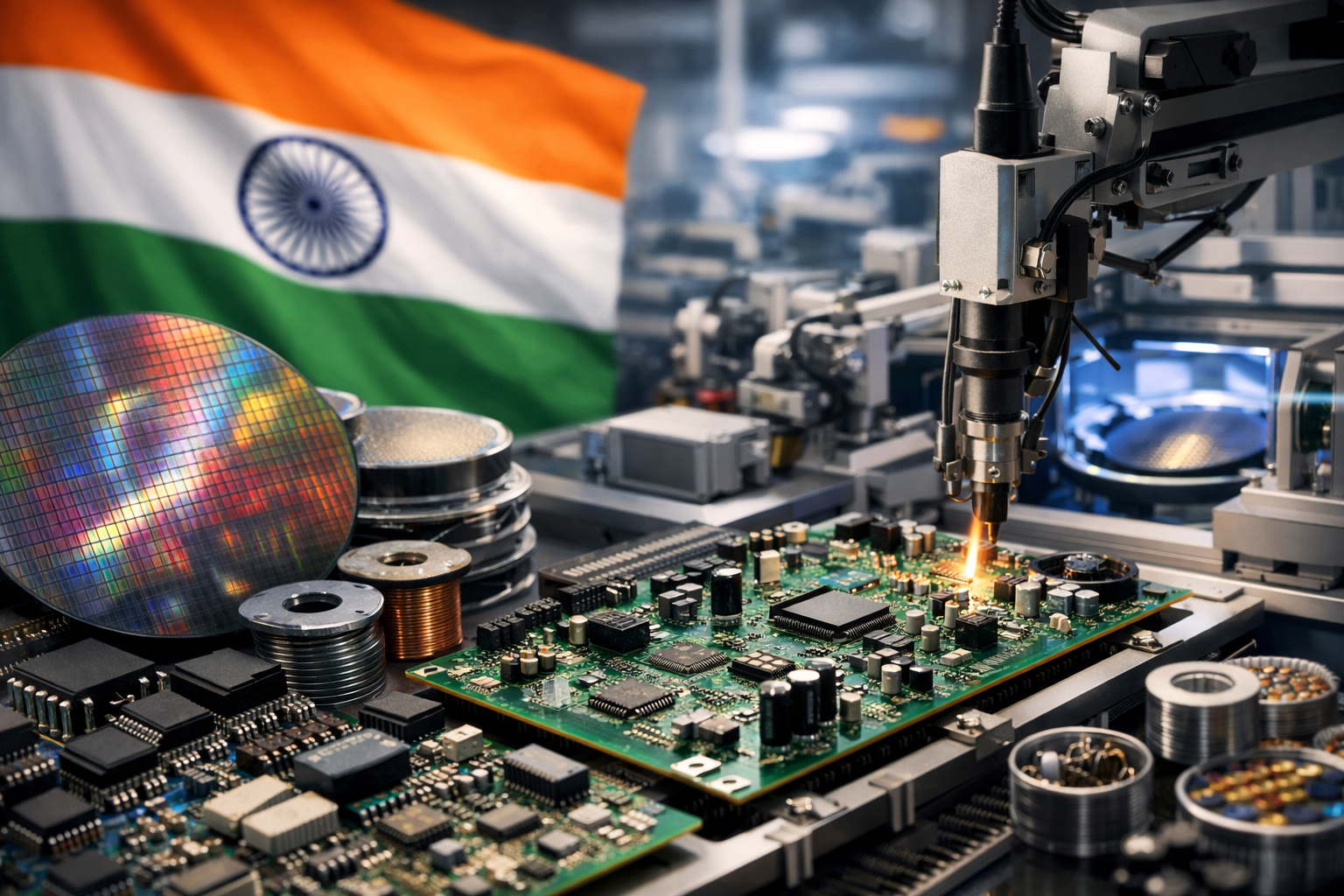
India has approved a new wave of electronics component investments as global manufacturers adjust supply chains long centred on China.
The decision highlights a strategic shift by New Delhi toward building depth in component manufacturing, rather than focusing only on final assembly.
As geopolitical tensions, tariff risks, and supply disruptions prompt companies to rethink China-heavy production models, India is positioning itself as a viable alternative for critical electronics inputs.
The move, as reported by Bloomberg, comes under the government led by Prime Minister Narendra Modi, which has made electronics manufacturing a cornerstone of its industrial policy.
By targeting components used across devices and industries, India is aiming to embed itself more firmly in global value chains.
Government clears component proposals
The Ministry of Electronics and Information Technology approved 22 proposals under its Electronics Components Manufacturing Plan, clearing investments worth $4.6 billion.
According to a government statement released on Friday, states Bloomberg, the projects are expected to generate output valued at 2.58 trillion rupees, or $28.6 billion.
The approved proposals cover the manufacturing of 11 categories of components used in mobile phones, telecom equipment, consumer electronics, automotive systems, and IT hardware.
This marks a deliberate effort to move beyond assembly-driven growth and address gaps that have kept India reliant on imported parts.
Major companies involved include global electronics maker Samsung and domestic player Tata Electronics, underscoring broad participation from both multinational and Indian firms.
Reducing dependence on imports
According to Bloomberg, the government has said the projects will strengthen domestic supply chains and curb import dependence, particularly in segments where China dominates global output.
A key focus is on localizing production of high-value sub-assemblies such as camera modules and display modules.
These components account for a significant share of device costs and are critical to supply chain stability.
Developing domestic capacity is intended to shield India’s electronics ecosystem from external shocks while improving cost competitiveness over time.
By concentrating on components rather than only finished products, policymakers are attempting to ensure that more value is retained within the country.
Apple’s supply chain shifts
The policy push coincides with an expansion of manufacturing by Apple Inc. in India.
The company has increased the number of local factories assembling iPhones after shifting most US-bound production from China to India to reduce tariff exposure.
While India faces some of the highest US tariff rates globally, electronic goods have so far avoided steeper levies. This has helped sustain momentum in electronics manufacturing investments linked to global supply chain reconfiguration.
In November, the government approved a proposal by Aequs, an Apple supplier, notes Bloomberg, to establish a unit manufacturing mobile phone enclosures through metal casting, adding another layer to the local supply network.
Chip projects move toward production
India’s electronics ambitions also extend into semiconductor manufacturing.
As per Bloomberg, Electronics Minister Ashwini Vaishnaw said on Friday that four fabrication manufacturing facilities would begin commercial production this year.
These include projects backed by Micron and Tata, marking a step toward building domestic capabilities in a sector where China and East Asia have long held an edge.
Taken together, the latest approvals reflect India’s effort to align its industrial policy with global supply chain shifts away from China.
The post India clears $4.6B electronics component push as firms diversify from China appeared first on Invezz