
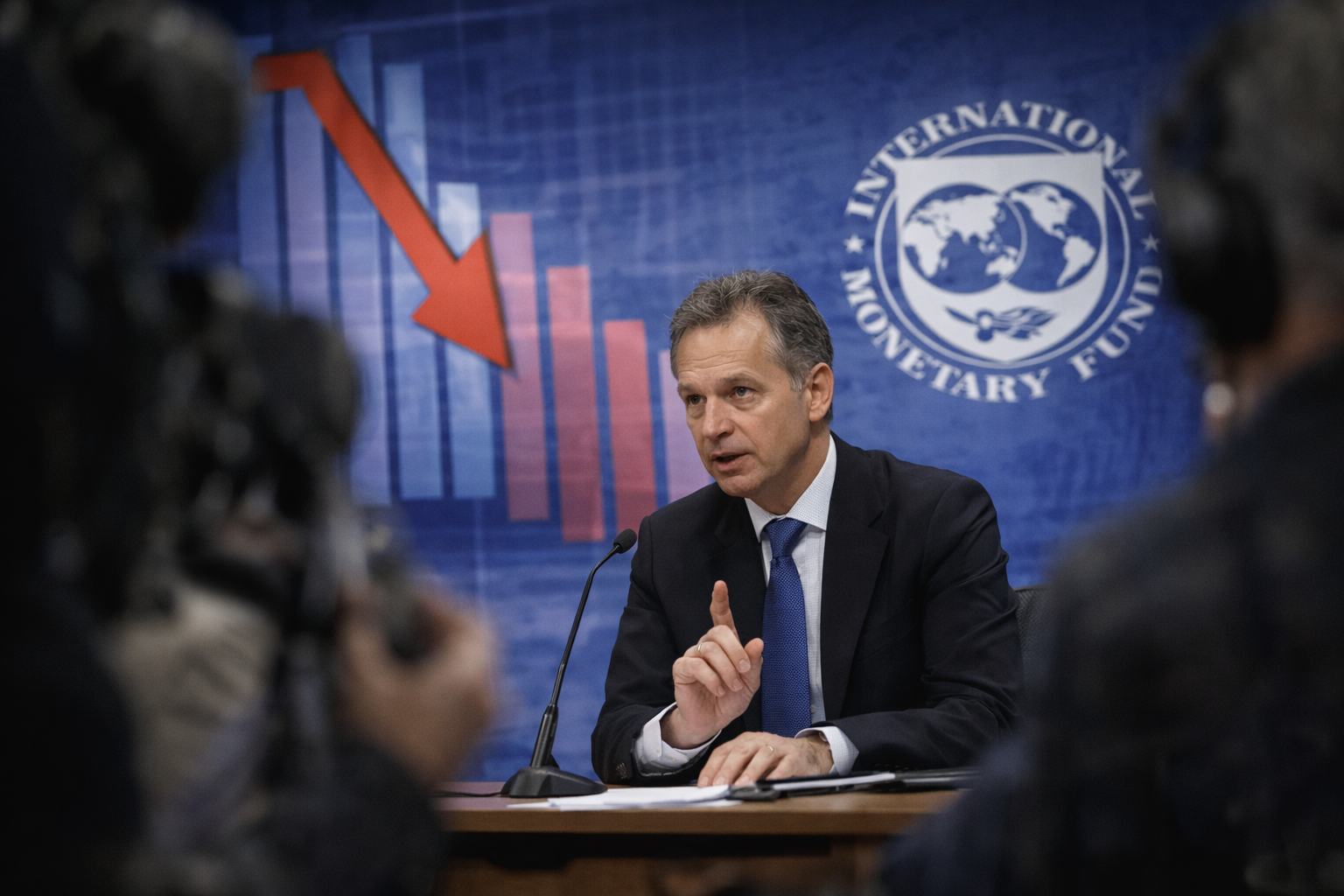
The International Monetary Fund on Tuesday revised down its growth outlook for emerging market and developing economies in 2026, citing rising energy and food prices along with uncertainty stemming from the Middle East conflict.
The IMF now expects these economies to grow at 3.9% in 2026, down from its earlier estimate of 4.2% in January.
The downgrade highlights growing pressure on countries that are more exposed to commodity price shocks, currency fluctuations, and investor sentiment shifts.
The IMF noted that the economic impact of the war will vary depending on proximity to the conflict, trade and financial linkages, reliance on remittances, and energy dependence.
The IMF warned that policymakers face difficult choices as inflationary pressures rise while growth slows.
“The current hostilities in the Middle East pose immediate policy trade-offs: between fighting inflation and preserving growth and between supporting those affected by the rising cost of living and rebuilding fiscal buffers,” the IMF said in its World Economic Outlook update.
The report emphasised that commodity-importing emerging economies with existing vulnerabilities are at the highest risk.
Higher import bills, weaker currencies, and reduced capital inflows could further fuel inflation and increase financial stress.
Baseline Outlook Hinges on Contained Conflict
The IMF’s projections are based on a relatively optimistic scenario where the conflict remains contained and short-lived.
Disruptions are expected to ease by mid-2026 under this baseline assumption.
However, the global lender warned that a broader or prolonged conflict could significantly worsen the outlook.
Sustained high oil and gas prices would deepen economic damage across emerging markets.
The IMF highlighted significant regional differences within emerging markets.
Emerging and developing Asia is expected to remain the fastest-growing region, though growth is projected to slow to 4.9% in 2026 from 5.5% in 2025.
China’s growth forecast for 2026 was slightly reduced to 4.4%, while India stood out as an exception.
India’s growth projection was raised marginally to 6.5%, supported by tariff relief and momentum from 2025.
Middle east and Central Asia bear the brunt
The largest economic impact is expected in regions closest to the conflict.
The IMF sharply cut its 2026 growth forecast for the Middle East and Central Asia by 2.0 percentage points to 1.9%.
For the narrower Middle East and North Africa region, growth is now projected at just 1.1% in 2026, marking one of the steepest downward revisions.
Country-level forecasts also saw significant changes. Saudi Arabia’s growth outlook was lowered to 3.1%, while Iran’s forecast was cut dramatically to -6.1%.
Egypt’s growth is expected to slow to 4.2%, reflecting pressures on commodity importers.
Mixed outlook across other regions
Sub-Saharan Africa is expected to see a modest slowdown, with growth projected at 4.3% in 2026. However, oil-importing countries without strong resource buffers may face greater strain.
In contrast, Latin America and the Caribbean saw a slight upward revision.
Growth in the region is now expected to reach 2.3% in 2026, supported by exporters like Brazil benefiting from higher oil prices.
Japan outlook and policy path
The IMF said it expects the Bank of Japan to continue raising interest rates gradually, though at a slightly faster pace than previously anticipated.
“In Japan, the policy rate is projected to gradually rise, at a slightly steeper clip than thought in October 2025, toward a neutral setting of about 1.5%,” the IMF said, in its World Economic Outlook report.
Japan’s economic growth is projected to slow to 0.7% in 2026 after expanding 1.2% in 2025.
Inflation is expected to moderate and converge toward the BOJ’s 2% target by 2027.
However, rising oil prices linked to the Middle East conflict are complicating Japan’s recovery and monetary policy path.
Higher fuel costs are adding to inflationary pressures while weighing heavily on an economy heavily reliant on energy imports.
Markets are now closely watching the BOJ’s upcoming policy meeting, though expectations for a near-term rate hike have weakened amid ongoing geopolitical uncertainty.
The post IMF trims emerging market growth to 3.9% amid inflation, conflict concerns appeared first on Invezz