
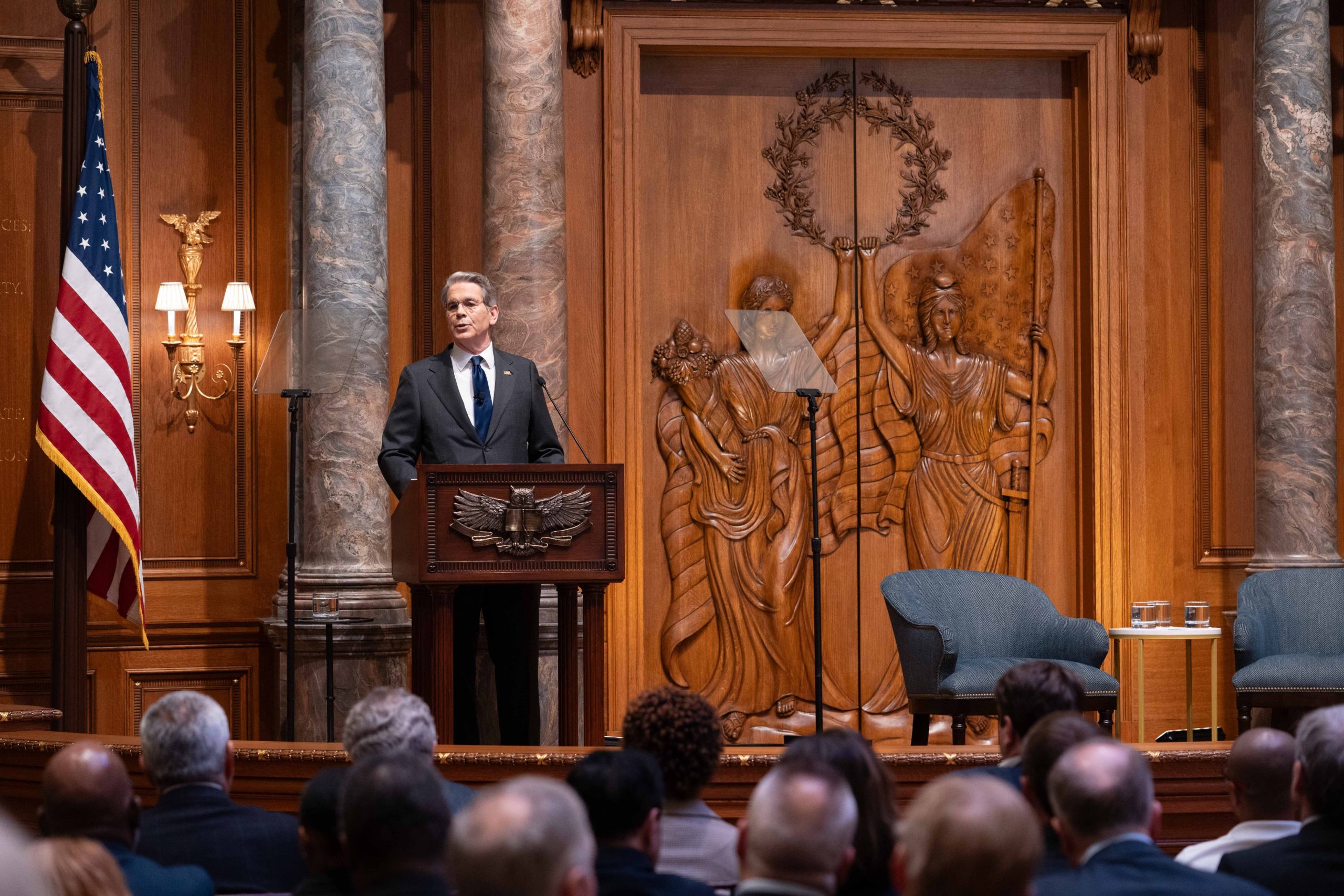
US Treasury Secretary Scott Bessent said on Tuesday that he remains confident that core inflation in the United States will continue to ease despite the ongoing war involving Iran.
Bessent also reiterated his call for the Federal Reserve to lower interest rates.
Speaking on the economic outlook, Bessent acknowledged that policymakers at the Federal Reserve may prefer to assess the evolving impact of the conflict before making policy adjustments.
At the same time, he signalled support for a leadership transition at the central bank, stating that it would make sense for Kevin Warsh—President Donald Trump’s nominee for Federal Reserve chair—to oversee the next phase of monetary policy.
Addressing the possibility of current Federal Reserve Chair Jerome Powell remaining in the role if Warsh’s nomination is delayed, Bessent said, “We want Kevin Warsh in as soon as possible.”
Warsh’s financial disclosures draw attention
Warsh’s nomination has drawn additional scrutiny following the release of his financial disclosures, which indicate that his personal wealth significantly exceeds that of recent Federal Reserve chairs.
According to the filings, Warsh holds assets valued between $131 million and $209 million, with additional holdings worth hundreds of millions attributed to his wife, Jane Lauder.
This places his net worth well above that of Powell, whose most recent disclosure for 2025 listed assets between $19 million and $75 million.
Warsh also reported earning $10 million in income through his advisory role with investor Stanley Druckenmiller, a position he has referred to as his “day job.”
In addition, he disclosed approximately $3 million in income from academic work at Stanford University’s Hoover Institution and engagements with several Wall Street firms.
Fed Minutes show growing divide on rate path
While Bessent expressed confidence in declining inflation, minutes from the Federal Reserve’s March 17–18 meeting suggest a more complex internal debate among policymakers.
A growing number of officials indicated that interest rate increases may be necessary if inflation continues to exceed the central bank’s 2% target, particularly in light of the inflationary pressures stemming from the war.
“Some participants judged that there was a strong case for a two-sided description of the (Federal Open Market) Committee’s future interest rate decisions… reflecting the possibility that upwards adjustments… could be appropriate if inflation were to remain at above-target levels,” the minutes said.
War adds uncertainty to inflation and growth outlook
The conflict, which escalated on Feb. 28, has introduced fresh uncertainty into the economic outlook, particularly through its impact on oil prices.
According to the minutes, “many participants pointed to the risk of inflation remaining elevated for longer than expected amid a persistent increase in oil prices.”
Officials also raised concerns that sustained increases in energy costs could feed into broader inflation trends and shift longer-term inflation expectations.
“Higher input costs would be more likely to pass through to core inflation,” the minutes noted, adding that progress toward the Fed’s 2% target could be slower than previously anticipated.
Despite these risks, the Federal Reserve held its benchmark interest rate steady in the 3.50%–3.75% range in March, while maintaining guidance that leans toward future rate cuts.
“Most participants” continued to view rate reductions as part of their baseline outlook, particularly if the conflict persists.
They warned that a prolonged war could weaken labour market conditions, reduce household purchasing power, and dampen global growth.
The post Bessent sees cooling inflation despite war, urges Fed rate cuts appeared first on Invezz